Order, Discipline, and The Rise of The Professional Kitchen
As food began to carry more meaning, it not only changed the way people ate but also changed how kitchens had to function. We can see that shift in the way Jean Anthelme Brillat-Savarin writes about dining in The Physiology of Taste, or Meditations on Transcendental Gastronomy, especially when he describes early restaurateurs and the environments they created. When he talks about Beauvilliers, a famous 19th-century restaurateur, he pays attention to everything around him. The dining room, the staff, the cellar, all of it had to work together in a way that people could feel, even if they could not quite name it. That kind of consistency takes effort. It does not just happen on its own. “Beauvilliers was one of the most famous restaurateurs of Paris. He was the first to have a fancy dining room, handsome, well-trained servers, a fine cellar, and a superior kitchen. When more than one of those we have just mentioned tried to equal him, he kept the upper hand with ease, since he was already so far in advance in following the progress of gastronomy.” (Brillat-Savarin, 319).
Once dining became something people paid attention to, something tied to status and experience, it required a different level of control behind the scenes. The kitchen not only functioned on instinct or repetition; it had to produce the same result, over and over again, at a level that met expectations, just as it does today in high-end restaurants all over the world. And that is when things begin to shift more visibly. At this moment, Auguste Escoffier steps in and changes everything.
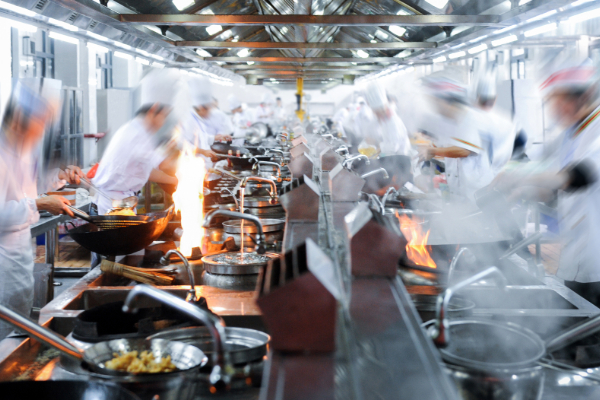
Escoffier was quite the organizer. He brought structure to something that had been far more fluid up until that point, turning the kitchen into a hierarchy with clearly defined roles, responsibilities, and expectations. Every station had a purpose, every person had a place, and everything moved with a level of discipline that made consistency possible at scale. “He designed this system around a military model of the chain of command, where organization, efficiency, and clearly defined duties shaped the way a kitchen functioned.” (Chefs Resources).
That same attention to structure shows up in the dining room as well, which I hadn’t fully connected until I read Recipes for Respect. Zafar writes about Tunis G. Campbell’s The Hotel Keepers, Head Waiters, and Housekeepers’ Guide, noting that he outlines a style of dinner service built around what he calls “drills,” in which movement, timing, and coordination are practiced and refined until they become second nature. His approach isn’t drawn from a military model, but instead from circular patterns found in West African performance traditions. It still carries precision, but there is also a sense of flow and intention in how the work is done. And once this kind of structure is in place, whether in the kitchen or the dining room, this euphoric authority attaches to the person leading it. The chef becomes a position with proud recognition.
The chef leads, directs, and controls the outcome of the entire gastronomical experience. Authority begins to concentrate in one place, becoming part of a system that is taught, repeated, and maintained.
Each position carries its own weight. There is a sense of pride and a desire to do it well, to refine it, and to be known for being good at that one thing. Whether it is the saucier, the garde manger, or the pastry chef, each role requires focus and discipline, and over time, people begin to identify with the work they are responsible for within the kitchen brigade. Suddenly, there is a drive in the kitchen to do their part well, sometimes better than the person next to them…which raises a question for me.
Is that drive about the work itself, or is it about being recognized for it? Furthermore, if recognition does start to enter the picture, is it the same kind that the cookbook writers in Recipes for Respect were after?
Earlier on, that kind of pride did not really go anywhere beyond the kitchen. It stayed right there in the work. However, as everything became more structured and more visible, a shift happened. Being good at what these chefs did was not just about the work anymore. It started to edge into being known for it.
What this created was a system where the work could be controlled, repeated, and trusted, and more importantly, where one person could stand at the center and be known for it. And once that kind of structure was in place, it did not stay hidden for long. It opened the door for the chef to step out from behind it, to be seen not just as someone doing the work, but as someone people began to recognize. And that is where things start to open up in a much more noticeable way.